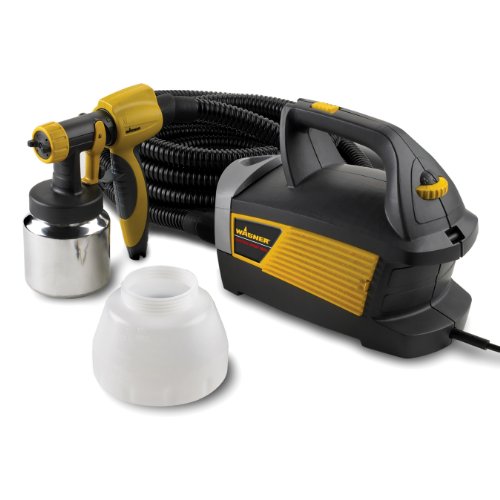
 Buy Wagner 518080 Control Spray Max HVLP Sprayer
Wagner 518080 Control Spray Max HVLP Sprayer Product Description:
- Powerful Two Stage Turbine sprays latex, as well as thinner materials such as lacquers and stains
- Variable Air Pressure Control means less overspray with thin materials
- 20 Foot High Flex Air Hose extends your reach
- 3 spray patterns - select the best pattern for your job
- Variable flow control covers large spray surface down to detail work
Product Description
Wagner 518080 Control Spray Max HVLP Sprayer
- Powerful Two Stage Turbine sprays latex, as well as thinner materials such as lacquers and stains
- Variable Air Pressure Control means less overspray with thin materials
- 20 Foot High Flex Air Hose extends your reach
- 3 spray patterns - select the best pattern for your job
- Variable flow control covers large spray surface down to detail work
Need more information on this product? Click here to ask.
Customer Reviews
Most helpful customer reviews
282 of 283 people found the following review helpful. Wagner Max HLVP Sprayer
By John T. Merryman
I had purchased another Wagner sprayer to use refinishing my kitchen cabinets. Unfortunately, I bought the wrong model. After doing some cabinet doors and not being satisfied, I called Wagner technical support.I described what I was attempting to do and the lady told me that I needed the Max HLVP unit.I used it yesterday for the two base coats and then this morning for the top coat of polyurethane. I couldn't be happier with the results!The unit is light and has plenty of power.I was spraying heavy interior latex and then satin polyurethane.It takes some playing to understand the best settings on power and flow. But, once you get those dialed in and are consistent in your spray angles and distance, the unit will give you professional results.It is very easy to clean and comes with two cups for small and larger jobs.I plan to use this to finish the balance of the kitchen cabinets and then on multiple other interior and exterior jobs.
173 of 178 people found the following review helpful.Quick Review
By Steve
This is just a quick review documenting my first (short) experience with this sprayer.I just bought and tried this sprayer and so you understand, I know very little about these. The reason I bought this particular sprayer was cost and I figured that the outboard turbine would be more powerful that the ones with the turbine built on the handle.I have previously owned an airless sprayer and it was useless except for jobs where quality wasn't important. The previous sprayer would constantly spit and I had no control over the spray pattern. I wasted a lot of paint painting a fence with it. Moving on...I am getting ready to paint some rooms in my house and figured that I would try this sprayer to get an idea of how to use it before I got serious with it. I was using latex paint straight out of the can with no thinning... I was curious about how that would work. There are only three adjustments on this gun... air flow, paint feed, and spray pattern. I set the air flow at its lowest setting, pulled the trigger, and nothing came out. I kept increasing the air flow until I got a spray, which was (for the material I was using) near maximum output. Paint delivery was smooth and consistent, although the amount of paint coming out was less than ideal if you were painting a wall. I was only painting a door and frame. I tried the different spray patterns and they all worked as expected. Since there were no "stops" I was curious about where to turn the spray head to get the desired pattern. As it turned out, it was easy. You could "hear" and "feel" the air change as you turned the nozzle. The spray patterns were fairly tight and over spray was minimal. After I was done, clean up was a breeze compared to cleaning brushes and paint trays.Three more things about its use... being a sprayer, I envisioned this cloud of paint being shot around the room getting on everything. That did not happen. I was also concerned about this being a non-bleeder type of HVLP, as "bubba" mentioned. The air never stops coming out of the nozzle, even when the trigger isn't being pulled. It didn't smear the paint and the air was free of paint when the trigger wasn't pulled. I also tried it with water with interesting results.As for the door and frame... It looks great, much better than the last time I painted it with a roller and brush.As I said, this is a preliminary review and I will report back after I finish the house. All I can really say is that with un-thinned latex paint and a small job, this product met and exceeded expectations.What I have gleaned from this experience is that getting a good spray pattern is determined by the amount of air and the amount of paint being drawn into the air flow. If this is off, the results will be less than perfect.More to come...
175 of 182 people found the following review helpful. Perfect for certain types of jobs
By S. P. Authement
SUMMARY:Great product for the money, but only for certain jobs! I would recommend it for any outside work, but would not recommend it for painting interior walls, as the effort required to minimize overspray and obtain the perfect dilution/spray velocity outweighs any gains in speed or ease of use.DETAILS -- FIRST ATTEMPT::WALLSThis Wagner has the most hits of any sprayer on the internet, and you can find many video blogs reviewing the product. However, what is lacking of sprayers in general are first-hand accounts of actual end users (especially first-time users). This Wagner is my first paint sprayer. Last year I repainted the entire inside of my house; walls, trim, doors, shelves and all in preparation to move out and get a new house. All of that work was done with traditional rollers and brushes. When we purchased our new house I was desparate to find some way to speed up the process. I researched many sprayers and read many reviews. I found many positive reviews for sprayers in the $800+ range, but was unwilling to commit to that kind of purchase having never used a sprayer. With the Wagner in the $100 range I figured even if it was a bust it was worth the effort.The first two times I used the sprayer was to paint the walls in the dining room and kitchen area, as these were the smallest wall surface areas in the house, and had flooring that was soon to be replaced, so messes were of little concern. The sprayer is very easy to use -- simply dump paint in the hopper, twist-n-lock the spayer assembly together, turn on the power, and push the trigger.Having not ever used a sprayer before, my wife and I spent a great deal of time blue-taping and laying down dropcloths. I taped all trim and I ran a layer of tape along the ceiling where it butted up against the walls, just in case. I had planned to "practice" with all those safety things in place, then decide which I could forego in all the rest of the rooms.It turned out that even the blue tape and dropcloths were not enough to keep all of the overspray out. During the process I stopped to go to the hardware store and purchase a paint shield and some painters paper. I added the painters paper to the ceiling and ended up having painters paper, blue tape, and a paint shield in place while painting the upper edge of the wall. I was disappointed to *still* have a small bit of overspray in a few area of the ceiling. I also tried diluting the paint and adjusting the velocity of the air, but never seemed to achieve the right combination. The problem with diluting is the paint can says, "See sprayer for dilution instructions", and the sprayer says, "See paint manufacturer for dilution instructions". I learned that too much dilution will cause the paint sprayer to "spit" and the paint to run.In the end I completely abandoned the sprayer for the walls and went back to the tried-and-true rollers. I am sure I could have achieve the results I wanted with the sprayer, but it would have taken such a long time as to negate any benefits from the sprayer -- the main reason I bought the thing was to hasten the painting process!DETAILS -- FIRST ATTEMPT::DOORSAfter rolling all the walls, I decided to give the sprayer a second chance on the doors. I removed several doors and placed them outside against a wall lined with dropcloth. Taking a tip from a painter, I nailed paint stirs to the top of the doors to keep them from butting directly against the wall. After lining them all up, I filled the sprayer and got to work. This time I skipped the dilution; I went full strength and simply turned up the velocity all the way to get the paint flowing as I did not care about overspray.This worked flawlessly! I have never painted doors this fast. In fact, these were all panel doors which are notoriously hard to paint with a brush. I kid you not that I had half a dozen doors, front and back painted in less than 30 minutes easily. I had some minor dripping on the first door, but after acclimating to the paint viscosity, all other doors look great!CONCLUSIONFor the money this is well worth the investment for anything other than painting interior walls. In fact, if you are used to using sprayers you probably will have success even on interior walls (if you do, please tell me how!). I can imagine painting fences, chairs and other items outside would be even easier than doors as literally no prep (dropcloths, etc.) would be needed.
Latest Price: See on Amazon.com!
More Info: See on Amazon.com!
See Customers Review: See on Amazon.com!
