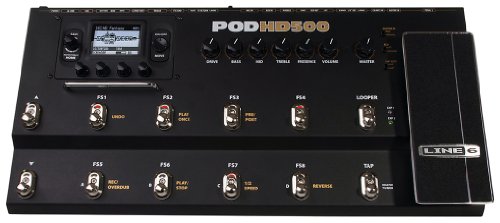
 Buy Line 6 POD HD 500
Line 6 POD HD 500 Product Description:
- 16 HD Amp Models, Up to 8 Simultaneous Effects, 512 Preset Locations.
- Balanced XLR Outputs, MP3/CD Input, Variax Digital Input (VDI).
- Metal Chassis, Pedal and Footswitches, Software Editor/Librarian.
- Assignable MIDI Footswitch Controls, Tap Tempo, Chromatic Tuner.
- Aux Expression Pedal Jack, 5-Pin MIDI Input + Output/Thru.
Product Description
Are you ready for this??? Of course you are - you asked for it! Here's the thing we've all been waiting for: an amp emulator that (gasp) actually behaves just like the amps it emulates. Take that in for a moment. We're not just talking about the sound of the amps, the Line 6 POD HD500 actually responds to your guitar's volume, playing style, your pickups, your signal path, etc, exactly like the amps it sounds like. How does the POD HD500 do it? No clue. We know it has something to do with a modeling engine that uses something like 10 times the info and way more variables then regular modelers, but that's where it all just becomes technobabble. The important thing is that you've never heard phenomenal amp modeling till you've plugged into a Line 6 POD HD.
Customer Reviews
Most helpful customer reviews
57 of 60 people found the following review helpful. Actually 4.5 stars, but I rounded up... GREAT SOUNDS! THE FIZZ IS GONE!
By P. Hamm
Before we get started, I am more "pro" than amateur. I work at a church as a pastor of Worship Arts and use this in my work. But I hesitate to say I'm only "pro", because "amateur" means you do something purely for the love of it... and I feel that way about music... So...First... the models I've tested are far and away more realistic to my ears than other modelers I've used, which includes Logic Studio's amps (these sound almost as good btw), POD X3Live and XTPro (the HD models are noticeably better... and the fizz is GONE GONE GONE), the original POD and 2.0 (which sounded the same to me and made me happy at the time), and the ToneLab SE (which I missed for a while, but not anymore).I made a few patches for one of my guitars based on having a Bassman 4x10 alongside the Dr. Z, and it is the coolest sound I've ever made with this guitar... easily. Better sounding, to my ears, than the real amps I've been using (maybe because I put them off stage and don't run them very loud). I ADORE the sound of this unit.Oh, and as always... forget about all the pre-sets. They're probably all as useless as you imagine they might be.Now the bad news. And it's significant... for some...First off, editing is clunky like it was on the XT and X3Live. Just forget about trying to use the display. Connect to a computer... Seriously. When you start from an init patch, you only get lucky, it seems, to manage to coax it into "two amp" config...Next, The functionality of this unit is exaggerated by it's specs. You will almost certainly NOT be able to do 8 FX at once the way you're thinking. Why? Let's say you use an XT or a X3. think about what you're used to.You start with 8 FXSubtract effect banks for...1. volume pedal (you need to use an effect bank). You might be able to use an analog pedal, but I like my volume after my compressor... so I have to do it in the loop I guess...2. FX loop (only works with an effect bank... Line6, is there any way you can make this always active in a firmware upgrade? Seems like you could.)3. Noise Gate (used to be always available... don't worry if you mix this with the M13 as I plan to do, though, as the M13 has a great gate). I mostly use clean or just barely broken-up amps, so I might be able to skip this.4. Wah (this is always available and active in the X3 and below).5. Post-EQ. The X3Live had a final EQ before final output that I liked a lot. in addition to all the other FX, too. You need to dedicate an FX bank now.SO... you might only have 3FX left. For me, put in a clean boost and tube drive (which I think sound better in this box than they did in the M13. Probably because they're "digitally part of the signal" is all I can think) and a verb for the amp. No slots left. What if you need delay and modulation? EEK! I have to re-think the way I use FX in this box. Still evaluating how that will work for me.What if you're a guy like me who was using the X3Live (occasionally) as a one-box solution for a dual-voice guitar. (All my guitars have piezo bridges.) No dice.I will have to use an acoustic preamp. No matter. I have one. I will probably dedicate a "null" amp to bring this signal into the unit and mix it.In addition, there aren't as many computer-recording routing options as the X3Live, and the SUPER-sweet ability to switch between two FX chains in one patch (instead of switching programs) is gone. As far back as my old Vox ToneLab SE, I could literally switch channels from one amp/cab to another in the same FX chain. You could do something similar on the X3Live. Not here. Also... Line 6, why on earth can't you make the Midi in and out work as a USB Midi interface with this unit? How complicated can that really be?In short... the X3Live has significantly... SIGNIFICANTLY more flexibility imho than this unit, for many of us at least, and ought not to have been discontinued imho. For some of you, it's still a viable option.You also still might need your other FX!I thought it might be possible that this unit, even if I needed to use my AG Stomp for my acoustic side again (which I'm happy to do) would bump my M13 off the stage. It did not at first, but after a while, I did indeed get rid of the M13, and don't miss it.. That said, I think from what I'm hearing that some of the FX (especially the dirt pedals) work FAR better inside this box than they do in the M13 when you connect it to a POD or amp.My favorite patches so far that I've made (which use the Bassman model and the UNBELIEVABLE Dr. Z model... far and AWAY my favorite amp model EVAH!) don't leave any room for modulation or other special FX. (I'm not a "switch whole patches on the fly" guy. I turn FX off and on.) But after a bit of tweaking and patch-making, I discovered that for my sounds, I didn't need dual amp chains that often, so I have all my flexibility back...So am I complaining about these limitations? No. Because the sound of this unit is so extraordinary. I'd take off a full star for this shortcoming, but the fact is the unit sounds good enough that I can't do it.There will, at some point, I hope, be a next-generation of this technology which will possibly address some of the usability shortcomings, but I have to say, for this price, I am totally satisfied with the sound!In the meantime, am I willing to trade the flexibility of my former rig for the sound of this one? Heck yes, it sounds that good. I even love the models of amps I know I'll never use for the first time ever.... And after a few months of experimenting, I was able to make patches that completely worked for my two-voice guitar stuff... with NO additional outboard gear if I didn't want. So I've simplified to where I wanted to, and no longer feel like I'm really compromising anything.So... started with a rig consisting of the HD500, and sometimes an M13, and an acoustic preamp (currently a Yamaha AG-Stomp) mixed in with the HD signal through the aux input. I've now gotten to the point where I can do everything I want, if I need, without the additional pedals, and I sold the M13. I kept a few analog pedals and such that I just like, but rarely take them out of the house anymore.I'm only nit-picking so that you will know all the trade-offs. For what I have been fantasizing about, basically an M13 in form and function with a handful of amp models shoved in the box, this is as close as we're probably going to come. And, did I mention... the SOUND! It's seriously great!UPDATE! I have learned that I will indeed have no problem replacing my M13 as well, and sold it off. I thought I'd miss it, but I don't.UPDATE! As of February 2012, I have supplemented this product with a black James Tyler Variax JTV59 (Korean), and it's a marriage made in heaven! If you are going to go with this product, and if you are looking for a new guitar, check out the new Variaxes. Totally amazing.
18 of 19 people found the following review helpful.Big improvement over previous Pods
By P. Edwards
My advice to anyone trying this unit out in a store. Disable all the effects and just play with the amp sims alone.It's not that the effects are bad in this unit, they're very good quality wise, though perhaps not as in depth as you'd get on a Boss unit. But all the presets have been made for the synth at heart guitarists, and they mask the real star of this unit, it's amp sims.The amp sims themselves are all decent speaking as more of an amp purist who normally hates sims. The thing it bear in mind with all amp sims is that firstly they're their own thing, use them as a new stomp box or effect and enjoy them as that rather than expecting them to replace real high end tube guitar amps. And secondly they're simulations for how one amp sounds when cued up a certain way in a recording studio with a specific engineer, desk etc. This means they may not be your sound, I think they're a cool sound and versatile enough, but you may feel differently. They're obviously not going to be quite as versatile as their real world counterparts as a result of this, it's like electronic drums, sometimes you just want something that sounds badly tracked, or just tracked a different way. This sounds like an amp tracked very nicely in a modern way, whether that's a sound you'll want to hear in a couple of years, who knows, right now it's good and state of the art.The sims in the Pod HD really are pretty impressive as far as amp sims go though, especially the Marshall. It's great to dial back the volume on the guitar and get it into that crunchy territory rather than the usual fuzz like digital distortion/clean mix. These sims are much closer to reacting the same way a real tube amp reacts and crucially once you disable the gates and the rest of the bumpf are a real blast to play, it's actually fun. There's much less latency than in previous Pod models such as the X3, so if you're sensitive to that you'll enjoy the HD a lot more.The downsides to the Pod HD500 are as follows.1) The DSP limit is soon reached, especially if you use the Dual Amp sim setup. This is a hardware limit.2) Setting up patches is best done via USB rather than in the tiny monochrome LCD and fiddly interface.3) The aforementioned LCD is quite faint when lit up. It really should be much higher contrast, I could see this being a problem on stage.4) The preset patches need to all be binned.5) There's a slight midrange scoop and EQ curve that makes the sound slightly less punchy than you'd expect when recording. It would be nice if Line6 could make the sound a little more flat/neutral when going Line In. It sounds fine when through a nice amp though.6) No the fizz is not all gone... but it is significantly reduced. Not all the amp sims seem to have that nice roll off that the Park and other Marshall amp sims have. Certain ones seem to have had more love lavished on them. The Gibson and Marshall amps in particular stand out head and shoulders above the others, which while good seem to veer more into the digital area, especially the higher gain amps (dialing back just gives you that primitive digital clip mix sound).7) If you're into noise guitar then you'd sooner go with a Boss unit. The "M" effects in the Pod are good, but they're workhorse standard effects, not stuff you can really get into the detail with and change to create radically diverse sounds. They're just not as in depth.8) While it has plenty of different reverbs, it lacks a really good deep and wide lush version, everything feels a little clipped and scooped.The upsides are :1) The amp sims, especially the Marshalls are among the best out there in terms of playability. Just remember to kill the other effects and add them back in as you need them when building patches or testing the unit.2) The interface it much better than previous units from Line 6 (though it is still fiddly).3) The fizz is much reduced, the sound really is much higher fidelity than previous floor units.4) This is a solidly built unit, the previous Pod floor units were not, this is now back to being Metal with reduced plastic usage, this looks like it can take a beating.5) If you hook it up to a computer then the Pod HD500 Editing software is pretty slick. It still lacks drag & drop of effects in the chain, but so far it makes setting up of patches very very quick and easy.6) The quality of the "M" effects are great for a Line 6 product.7) You finally have a good range of distortions and tones, from clean through crunch, through blues and through to heavy metal and even glitch tones. Most units excel only in one area, this is solid in them all.7) It's fun to play.Overall the positives far outweigh the negatives for me as I find it's rejuvenated me musically and satiated a need to explore new sounds.
10 of 11 people found the following review helpful. Sounds good and has the potential to get even better
By David Lee
I've had my POD HD500 for less than a week, so I'm still forming an opinion of the unit. First, the good news: HD modeling sounds good, much better than previous iterations of Line 6 technology. The output is more responsive to your playing and the amps themselves sound great. The effects are also good (same as the M13), and there's a good variety of them, enough for classic guitar pedalboard emulation as well as more exotic effects.Using two amp simulations side by side is also very effective--it's great to have a cleaner amp on one side and a dirtier amp panned hard to the other. Gives a great stereo image if you're playing in stereo. You lose the ability to add more FX models when you use two amps, as there's a limited amount of DSP power onboard and running two amp models uses a good deal of it. However, I've found there's still enough for basic things like a delay and reverb (although not some of the more complex reverb models) along with an overdrive pedal or two--so not bad, all in all.The presets are a mixed bag, but some of them are good in their own right and make good jumping off points for your own editing. Which gets me to the less-good side of the equation. Thus far, I find the onboard editing pretty cumbersome and non-intuitive. I'm sure using it more would improve this, but the point of an interface is to be intuitive and easy to use. Instead, it's rather arcane. Using the free software editor is better, but it too has a cumbersome interface, much worse than previous efforts like GearBox or POD Farm. Double-clicking on an effect doesn't select it for editing, you can't drag and drop amps and FX models on your virtual pedalboard. Instead, you use old-fashioned menus to enter parameters and the arrow keys to move FX models around after you click on them to select one. That sounds like a minor issue, but it's a step backward--feels like you're using an app from like 2000. Also, I've had lost USB connectivity while using the app, and weird, buggy behavior that requires reseting the unit to get things back to normal. I hope this is fixed soon with new drivers and an updated editing app. The software right now is less than stable (in my experience) and there's lots of room for improvement that I hope Line 6 delivers.When using the hardware, I find the Looper and Tap Tempo buttons too close to the expression pedal. If you're not wearing skinny shoes, you can hit the other buttons when trying to use those two buttons, resulting in unwanted patch changes or moves on the expression pedal when I'm trying to tap in a new tempo while playing, for instance. Also, there's no power button. You have to unplug the unit to turn it off, which is a poor design decision in my opinion.I haven't played live with the HD500 yet--I'm still building my basic patches and am nowhere near ready to depend on it in a live context. But from what I've heard so far, I expect to hold up sound-wise when I do. I've used modelers live before and know how they sound different between headphones and monitors to going through an actual PA. I think this one's going to sound rich and chunky enough to cut it, although time will tell (will update this with more info when I have feedback to share).All in all, the HD500 is a nice step forward, and delivers great value for the price. The hardware has a few design issues I take exception with, but I hope the software updates will make patch editing a smoother, faster, more elegant process as the raw power in the box is really excellent.
Latest Price: See on Amazon.com!
More Info: See on Amazon.com!
See Customers Review: See on Amazon.com!
